
You Don’t Need a Thick Skin — You Need Better Framing
“As a project manager, you have to have a thick skin. Things that go wrong land on you.”
Ah yes.
The official slogan of Bad Framing & Unclear Decision Ownership, Inc.
I hear this all the time. Usually said with a knowing nod, like it’s a badge of honor.
Spoiler alert: it’s not. It’s a warning sign.
Because when everything lands on the PM, one of two things is happening:
The PM is being treated like a decision-maker (they’re not), or
The PM is unknowingly absorbing accountability that belongs to leadership
Neither requires thicker skin.
Both require better framing.
The Lie We’ve Normalized in Project Management
Somewhere along the way, PM culture decided that:
Being calm while blamed = professionalism
Absorbing chaos = leadership
Taking the hit = part of the job
Nope. That’s not resilience.
That’s mis-positioning.
Project managers are not human lightning rods for organizational indecision.
What Project Managers Actually Own (And What We Don’t)
Let’s clear this up once and for all.
PMs Own:
Facts
Validated input from SMEs
Standard timelines grounded in reality
Options, tradeoffs, and implications
Clear documentation of decisions
PMs Do Not Own:
Technical accuracy (hello, SMEs 👋)
Resourcing decisions
Priority calls
Risk tolerance
Strategic tradeoffs
If leadership chooses Option B after seeing Options A, B, and C — the outcome belongs to leadership.
You don’t “wear it.” You document it.
Why Things “Land” on PMs (Hint: It’s Not the Skin Thickness)
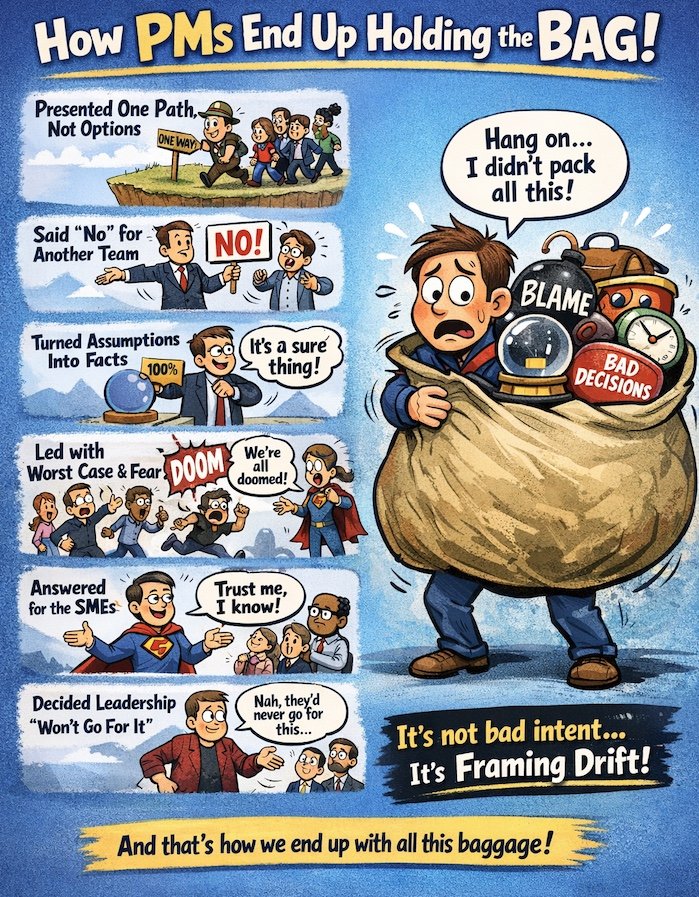
When PMs end up blamed, it’s almost always because one of these sneaky things happened:
We presented one path, not options
We said “no” on behalf of another team
We turned assumptions into facts
We led with worst cases and fear
We answered for SMEs instead of validating with them
We quietly decided what leadership “wouldn’t go for”
That’s not bad intent.
That’s framing drift.
And framing drift is how PMs end up holding bags they never packed.
The Framing Shift That Changes Everything
Here’s the magic formula that saves PM sanity:
Facts → Options → Decision
That’s it. That’s the job.
What That Sounds Like in Practice
“Our standard timeline for work like this is X.”
“Here are the variables that could influence it once we have full requirements.”
“If this becomes a priority, here are the ways we could accelerate — each has tradeoffs.”
“Here’s what we need from leadership to proceed.”
Notice what’s missing?
Doom spirals
“Everything that could possibly go wrong”
Pre-emptive nos
Psychic predictions about Legal, Security, or Procurement
The Secret PM Superpower: The Receipt
Want to know how seasoned PMs sleep at night?
They keep receipts.
Decision logs
Slides that say Option A / Option B / Option C
Notes that clearly state “Decision approved by ___”
Follow-ups that summarize what was agreed
So when something goes sideways, the conversation becomes:
“Here’s the decision we made, based on the information available at the time.”
Not:
“Why didn’t you stop this?”
Very different energy.
You’re Not Supposed to Be Tough — You’re Supposed to Be Clear
If your job constantly requires a thick skin, ask yourself:
Am I deciding instead of framing?
Am I presenting facts or predictions?
Am I offering options or dead ends?
Am I documenting decisions or carrying them?
Because clarity beats toughness every time.
The Line I Want Every PM to Memorize
“If we presented accurate facts, validated with SMEs, and documented the decision, the outcome doesn’t land on us — it lands where the decision was made.”
Or, if we’re being honest:
If everything keeps landing on the PM, the problem isn’t sensitivity. It’s framing.
Final Thought
Project management isn’t about being the toughest person in the room.
It’s about being the clearest.
And when you get that right?
Things stop landing on you — and start landing exactly where they should.
